How to Read Italian Birth Records from the 1800s (Full Guide + Examples)
Table of Contents
- What Italian Birth Records (1800s) Look Like
- Key Italian Words Found in Birth Records
- How to Translate an Italian Birth Record (Step-by-Step)
- Example of a Translated Italian Birth Record
- Types of Italian Birth Records (1800s)
- Where to Find 1800s Italian Birth Records Online
- Common Issues When Reading 1800s Records
- FAQ — Italian Birth Records (1800s)
- Need Help With Your Italian Ancestry Research?
If you’re researching your Italian ancestors, learning how to read Italian birth records is one of the most important skills you can develop.
Italian birth records from the 1800s may look difficult at first because of handwriting, formal language, and long sentences, but once you understand their structure, they become much easier to interpret.
This guide will teach you how to read, translate, and interpret an atto di nascita from the 1800s—even if you don’t speak Italian. You’ll find examples, key terms, common phrases, and clear steps you can follow for any record.
Need help reading or finding your Italian birth records?
I can locate or translate your ancestor’s documents quickly and professionally.

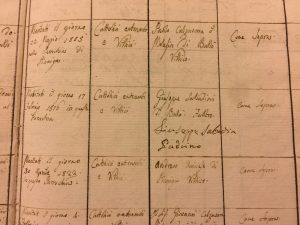
What Italian Birth Records (1800s) Look Like
Key Italian Terms Found in Birth Records
Date-related words
-
oggi – today
-
ieri – yesterday
-
addì – on the day
-
l’anno mille ottocento… – the year 18…
-
alle ore… – at the hour…
-
il mese di… – in the month of…
Family relationships
padre – father
madre – mother
figlio / figlia – son / daughter
marito / moglie – husband / wife
nato / nata – born (male/female)
Administrative terms
comparso / comparsa – appeared before
dichiarò / dichiarato – declared
nato da – born of
domiciliato / domiciliata – residing in
testimoni – witnesses
ufficiale dello stato civile – civil registrar
atto – act/document
How to Read an Italian Birth Record (Step-by-Step Guide)
Step 1: How to read the date and place in an Italian birth record
These are always in the opening lines:
“L’anno milleottocentquarantaquattro, addì venti del mese di maggio, in Atessa…”
This gives you:
-
year
-
day and month
-
municipality
Step 2: Reading the informant’s details in an Italian birth record
This is the person who reported the birth, usually the father.
Example:
“È comparso davanti a me Giovanni Rossi, di anni trentadue, contadino, domiciliato in questa città…”
Here you find:
full name
age
occupation
residence
Step 3: How to read the newborn information in Italian birth records
Look for the part where the informant presents the child:
“…mi ha dichiarato che alle ore tre antimeridiane è nato un bambino, che egli mi presenta e al quale dà il nome di…”
This section gives the:
time of birth
gender (baby boy/girl)
given name
Step 4: How to read the parents’ information in Italian birth records
Usually introduced by:
“figlio di” (son of)
“e da sua moglie” (and from his wife)
This part gives you:
mother’s name
mother’s age
mother’s occupation
residence of the parents
Often, the mother’s maiden name is included.
Step 5: Interpreting signatures in Italian birth records
Witnesses appear near the end:
“…in presenza dei testimoni…”
If the father couldn’t sign, you may read:
“Avendo il dichiarante dichiarato di non sapere scrivere…”
(“The declarant stated that he does not know how to write.”)
Need help with a specific birth record? Send it here.
Example Showing How to Read an Italian Birth Record (1800s)
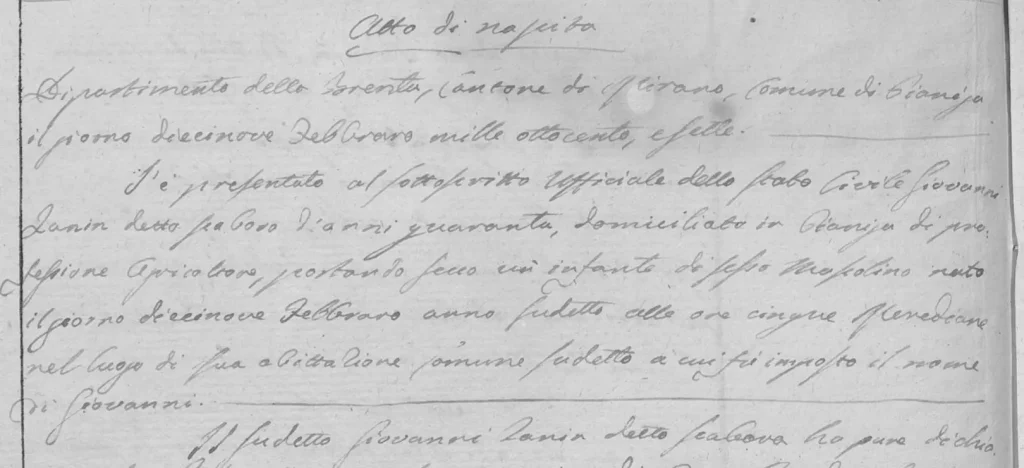
Example translation of an Italian birth record
Italian (simplified): “L’anno mille ottocento trentaquattro, addì ventitré aprile… È comparso Giovanni Bianchi, di anni trenta, contadino… ha dichiarato che alle ore cinque è nato da sua moglie Maria Rossi un bambino, al quale dà il nome di Antonio…”
English Translation: “In the year 1834, on the 23rd of April… appeared Giovanni Bianchi, aged thirty, farmer… who declared that at five o’clock was born of his wife Maria Rossi a baby boy, to whom he gives the name Antonio.”
This example helps you see the essential parts of the record and understand how information is typically presented.
Line-by-line reading of an Italian birth record
When reading an Italian birth record line by line, focus on the four core sections:
Opening formula and date – Identifies the year, day, month, and municipality.
Appearance of the informant – Usually the father or, in earlier years, a midwife; includes name, age, and profession.
Birth details – Time of birth, gender of the child, and presentation of the newborn to the registrar.
Parents’ information – Mother’s full name, maiden name (if present), age, and residence.
Breaking the text into these predictable sections makes even complex handwritten records much easier to interpret.
Types of Italian Birth Records (1800s)
Not all records look the same. The format depends on the historical period.
Napoleonic format (1809–1815)
Restoration period (1816–1865)
Kingdom of Italy format (post-1866)
Where to Find Italian Birth Records Online
1. Antenati — Italian State Archives
https://antenati.cultura.gov.it
Millions of digitized civil records.
2. FamilySearch
3. Local Municipalities (Comuni)
Found the record online but need an official certified copy? Portale Antenati and FamilySearch provide scans for research only. Consulates and citizenship applications require certified extracts from the Comune or State Archive.
Common Issues When Reading Italian Birth Records
Problems when reading old Italian birth records
Many Italian birth records from the 1800s present challenges due to aging ink, water damage, or inconsistent digitization quality. Some volumes may have torn pages or faded text, making certain parts difficult to decipher.
Additionally, names were often written phonetically, leading to variations such as Rossi/Rosci or Giovanni/Giovannino. These inconsistencies can create confusion when tracing the correct family line, especially in small towns where many people shared similar names.
Handwriting issues in Italian birth records
Handwriting is one of the most common obstacles when reading 19th-century Italian birth records. Registrars used elaborate cursive styles that varied from region to region, and some used abbreviations or flourishes that can obscure letters. Letters like s, f, p, and g often look nearly identical, and numbers may appear distorted or stylized.
With practice, patterns become recognizable, but beginners may find it challenging to distinguish between similar characters. In these cases, comparing multiple records from the same registrar can help clarify the handwriting style.
Can't Read the Handwriting?
19th century Italian handwriting is notoriously difficult. Send us the record and we'll identify the key details — name, date, parents — within 48 hours.
Send Me Your Record →Italy-based researcher. Fast turnaround.
FAQ About Reading Italian Birth Records
How do I read an Italian birth record from the 1800s?
By identifying the core structure: date, informant, newborn details, parents, and witnesses. The format rarely changes.
Are Italian birth records from the 1800s handwritten?
Where can I find 1800s Italian birth records for free?
Can you translate an Italian birth certificate for me?
Need Help Reading Your Italian Birth Record?
I can help you:
Translate Italian genealogical documents
Locate original birth, marriage, and death records
Contact Italian municipalities on your behalf
Reconstruct your family tree
Provide professional genealogical reports
I typically reply within a few hours.
About the Author — Moreno Brusauro
Moreno Brusauro is an Italian genealogy researcher specializing in locating, reading, and translating original Italian civil and parish records from the 1800s to the early 1900s. He works daily with State Archives, municipal offices, FamilySearch Centers, and historical parish registers across Italy.
With extensive hands-on experience helping clients from the U.S., Canada, Australia, and the U.K., Moreno combines expert archival research with modern genealogy tools to reconnect families with their Italian roots.
He has been featured in international genealogy content, including a U.S. genealogy podcast interview, where he shared insights into Italian record interpretation and research strategies.
Moreno provides professional services such as:
- Locating and retrieving Italian birth, marriage, and death records
- Translating historical Italian documents
- Contacting Italian municipalities and archives for clients worldwide
- Building family trees and conducting full genealogical investigations
- Assistance for Italian citizenship jure sanguinis
If you would like professional assistance with your Italian ancestry research, Moreno is happy to help.
📩 Contact:
info@italianrootsfinder.com
🌐 Website:
italianrootsfinder.com
🎧 Podcast Interview:
Get to know me on YouTube
⭐ Reviews:
Read client reviews on Google